
Top 5 Ways to Monetize a Job Board Website
Best revenue models for job board websites built with WordPress.

Proven rental business ideas you can actually build on WordPress, no developer needed.

Renting has become a practical alternative to owning things that people use occasionally. A car can sit unused for most of the week, a set of power tools may only be needed for one project, and event equipment can spend most of the year in storage. That creates room for businesses built around giving people access to useful products and spaces when they actually need them.
For entrepreneurs, this opens up plenty of rental business ideas worth exploring. You can build a rental marketplace around vacation properties, create a local platform for party equipment, or connect people with sports gear.
The idea does not always have to be broad, either. Some of the most practical rental businesses start with one category and one local market, then expand once the model has been tested.
Let’s dive in, starting with the platform question: what should you actually build this on?
Once you have a rental business idea, you also need to decide how you are going to build the platform behind it.
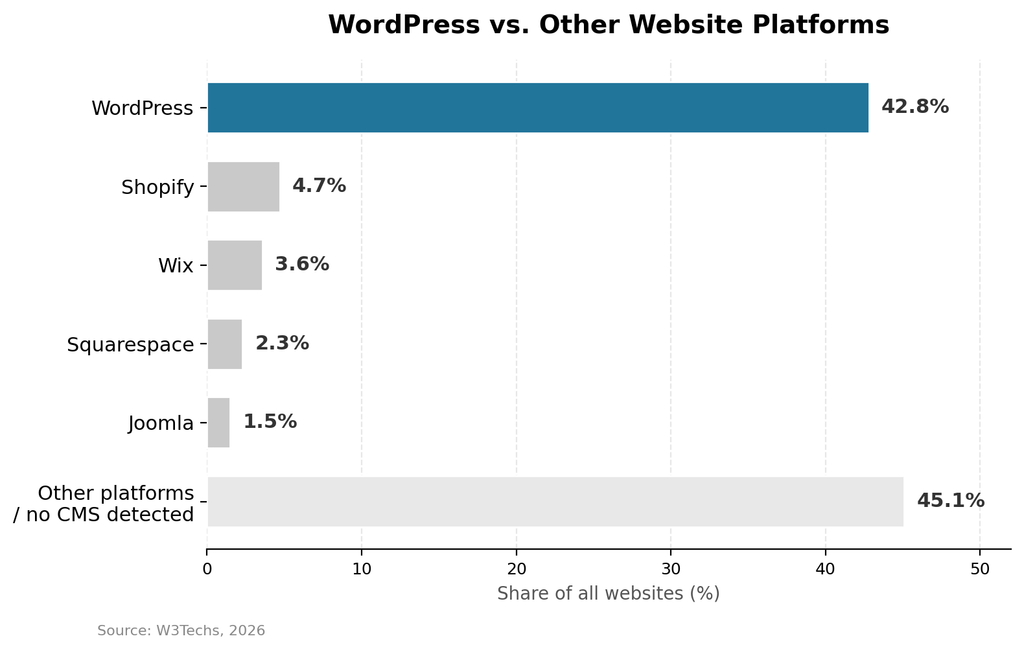
There are several routes you can take. A SaaS platform like Sharetribe can give you a ready-made system, but your website remains tied to that provider’s infrastructure, pricing, and product decisions. Vibe coding can be useful for getting an early concept together quickly, but you also take responsibility for turning that prototype into a reliable product. Building everything from scratch gives you maximum control, but it also means taking on the development, maintenance, and ongoing infrastructure yourself.
WordPress offers another approach. You can combine WordPress with plugins and a suitable theme instead of developing every part of the platform yourself. You control the website and can choose the tools around it as your needs change.
That last part is one of WordPress’s biggest advantages. It is an ecosystem rather than a single product. You can choose among different solutions for SEO, caching, backups, security, analytics, email marketing, performance, and other parts of the site. And there’s a nice irony here: you’re considering building a business around the idea that renting beats owning, but when it comes to your own platform, the opposite is true. The website, the code, and the customer data are yours outright, not something you’re leasing from a SaaS provider that can raise its price or shut down.
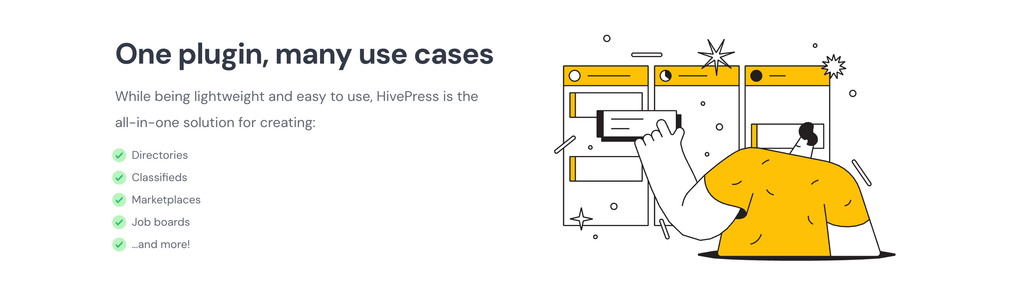
For a rental marketplace specifically, a WordPress directory plugin such as HivePress is one of the strongest fits available. It functions as business directory software in its own right, handling listings, vendors, custom fields, and other directory functionality. For anyone looking for a no-code builder, HivePress lets you set up marketplace functionality through the WordPress dashboard, no coding required, using its Marketplace extension.
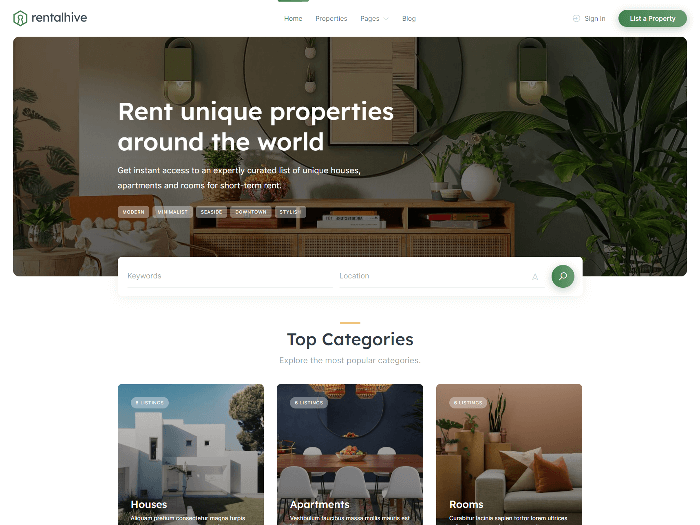
RentalHive builds on this foundation with a rental-focused design and a bundle of HivePress add-ons for marketplace, booking, and review management. That combination gives you what you need to launch a rental marketplace right away, and because none of it is locked to a single type of inventory, the same setup works for vacation homes, camping gear, or party equipment alike.
With the platform and the theme sorted, let’s see what you can actually build with it.
Vacation rentals are an obvious starting point, but that does not mean you have to build another general-purpose accommodation platform. A more focused idea gives you a better shot at making it work. You could concentrate on one destination, a particular property type, a group of travelers, or a region where local hosts need a dedicated platform.
Instead of thinking about how to create a website like Airbnb, think about who you’re actually building for. A platform for ski chalets in one mountain region behaves differently than one for city apartments aimed at business travelers, even though the underlying mechanics stay the same: guests search by date, browse photos, compare options, and book directly.
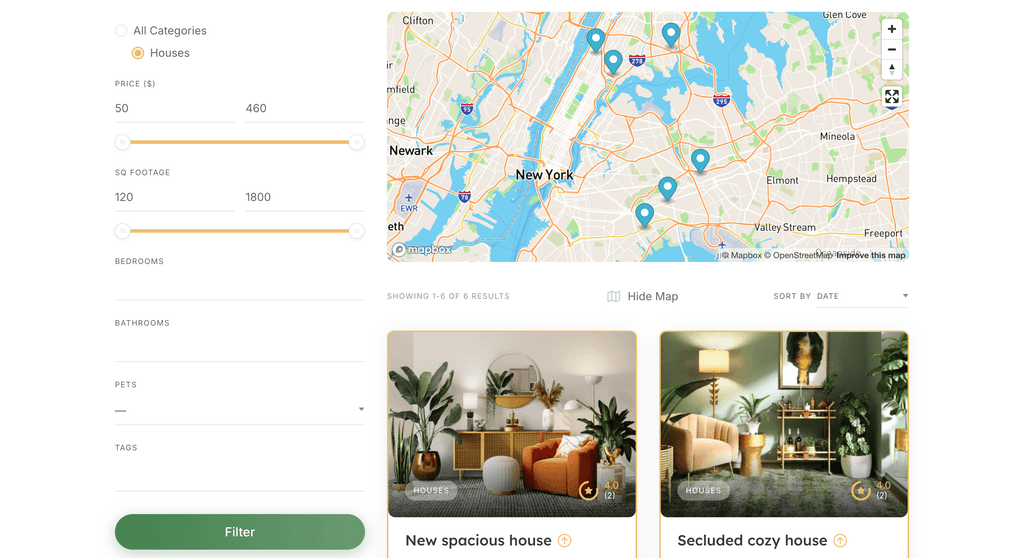
For this idea, you’ll probably need a handful of features working together: nightly and multi-night booking, availability calendars, location-based search or maps, flexible or seasonal pricing, reviews so guests can trust a listing before booking, and favorites so returning visitors can save properties they’re considering.
This is where RentalHive works well as a short term rental website builder. The theme comes with everything needed to launch a flexible vacation rental marketplace, built inside one ecosystem. Its live demo is a great example of a vacation rental website template done well: nightly bookings, availability management, and location-based search, all included.
A vacation rental marketplace can generate revenue through booking commissions, listing fees, featured listings, or additional services for hosts.
Party rentals might be the easiest idea on this list to get everyone to agree on. Nobody wants to spend hundreds of dollars on a tent, a photo booth, or a set of matching chairs they’ll use once and then store in a garage for the next three years.
That makes a party rental business naturally suited to a local marketplace. You can connect event planners and customers with suppliers in one area, then build a reputation around reliability, selection, and convenient delivery.
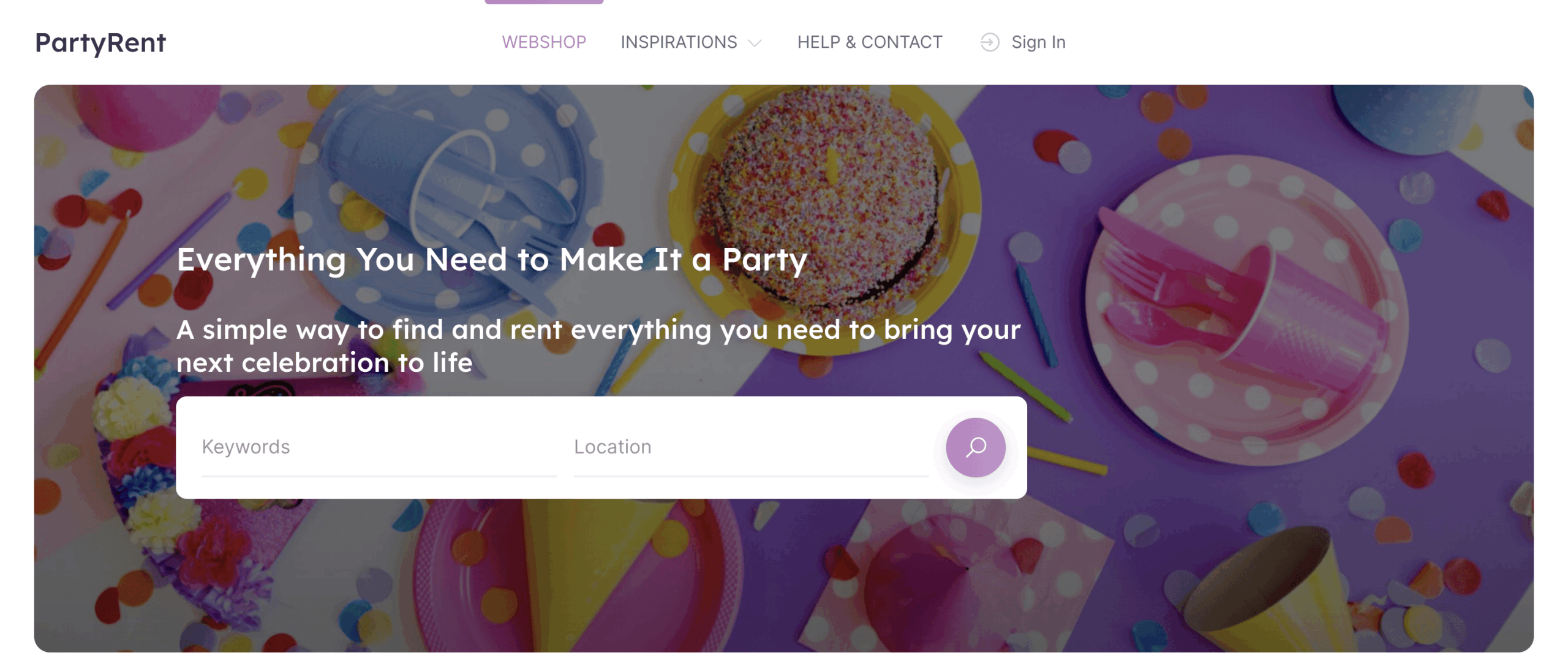
For a party rental marketplace, you’ll probably need two types of bookings working side by side: daily for tents, tables, and larger equipment, and time-based for things like photo booths or sound systems that only get rented for a few hours. RentalHive handles both through category-based bookings, so each listing type books the way it’s actually used, rather than forcing everything onto one calendar. Reviews, messaging, and favorites matter here too, since customers are trusting vendors with an event that only gets one shot at going right.
One extension worth adding on top is Requests, which lets customers post what they need and lets vendors respond directly. That’s especially useful for services rather than physical items, animators, musicians, or DJs who don’t have a fixed “listing” in the traditional sense, but still need a way to get found for the right gig.
If you’re working out how to build a party rental marketplace, that combination, flexible booking types plus a way for service-based vendors to get discovered, covers more of the category than a platform built only for physical rentals.
The revenue model can include booking commissions, vendor fees, charges for services such as delivery and setup, and affiliate commissions if you refer customers to partner vendors outside your own listings.
If you live in a tourist destination, or somewhere campers and RVs are already a popular way to get around, that local context is a natural starting point. You don’t have to build a vehicle rental marketplace that competes with a general car rental website. You could focus on a particular location, premium or specialty vehicles, motorcycles, vans, trailers, or recreational vehicles. Another direction is to start a camper rental business that connects travelers with privately owned campers and RVs.
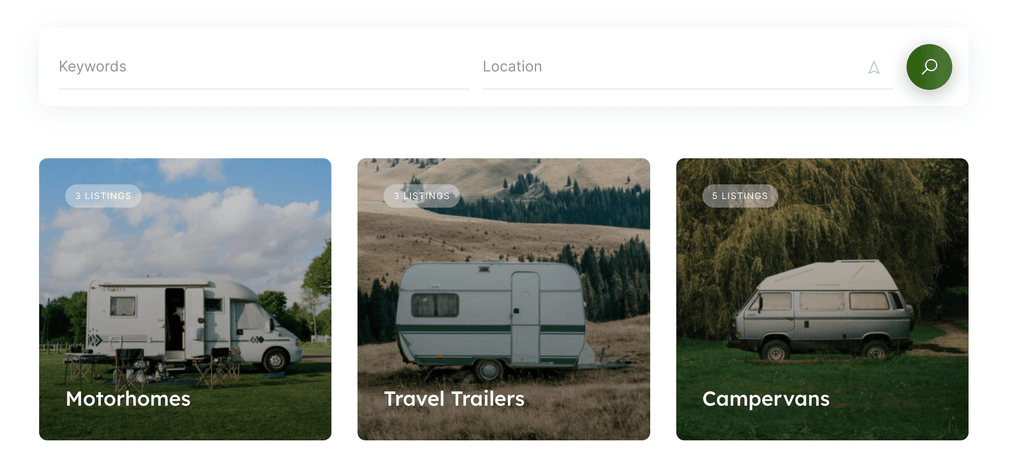
A vehicle rental marketplace usually needs a specific combination of features to work smoothly. Most bookings run several days rather than just one, so multi-day availability matters from the start. Refundable deposits matter too, RentalHive collects these at checkout, so a security deposit is built into the booking flow instead of handled separately after the fact. Pricing needs to be clear and itemized, since insurance, mileage limits, and other terms should be visible before checkout rather than buried in fine print. Listing photos carry more weight here than in almost any other rental category, since condition is a bigger factor for vehicles than for most other rentals, and location information matters just as much, since the pickup point is often as important to the renter as the vehicle itself. Direct communication rounds it out, since pickup arrangements and last-minute questions need a fast way to reach the owner.
Camper rentals are a good example of where longer bookings can affect pricing. Length-based discounts let you set a lower per-day rate the longer someone rents, so a week-long camper booking prices differently than a two-day one without any manual adjustment. Seasonal pricing can also make sense for vehicles that are much more popular during holidays and summer travel.
The business can earn through booking commissions, rental fees, additional charges, or services connected with the booking.
As with party rental marketplaces, equipment is one of those categories where the reason to rent is easy to understand.
A homeowner may need a pressure washer for one weekend. A photographer might need an additional lens for a specific project. A contractor may need a machine for a short job. In all of these cases, the customer gets access to equipment without having to purchase and store it permanently.
That makes equipment especially interesting for a marketplace because there are many possible directions. A platform could focus on construction tools, gardening equipment, photography gear, cleaning equipment, or a specific professional industry.
If you’re researching how to start an equipment rental business, one of the first questions is what information each listing needs. A camera may need sensor and lens details, while a power tool may need voltage and power specifications. A construction machine can require an entirely different set of attributes.
This is where flexible listing fields become particularly important, and it’s also where HivePress does most of the heavy lifting. The plugin is built around custom, category-based fields from the ground up, so setting up different attributes for a camera listing versus a power tool listing is a configuration task, not a development one. On top of that, stock availability and booking management let you keep things in place, so a popular tool doesn’t get booked twice for the same weekend.
You can also choose the business model that makes sense for the inventory. You could rent your own equipment through a single-vendor website, or let other owners and businesses list their equipment and charge a commission on transactions.
Baby equipment is a good example of a rental business built around convenience rather than novelty.
Traveling parents already have enough to organize without transporting a crib, stroller, high chair, or other bulky items. A local business that can have those products ready at a hotel, apartment, or vacation property solves a very specific problem.
That makes this idea especially suitable for a focused local business. You could operate in a tourist destination, serve a large city, or work with accommodation providers that regularly host families.
For anyone researching how to start a baby equipment rental business, trust becomes a major part of the proposition. Parents need confidence that the equipment is clean, well maintained, and accurately described. Reviews and direct messaging cover that trust gap, and both come as free HivePress extensions, so there’s no added cost to including them from day one. The booking model itself works much like any short-term rental marketplace: availability by date, with pickup or delivery windows instead of an overnight stay. A single-vendor model can also make sense at the beginning because it gives the business direct control over its inventory and operating standards.
The main revenue source can be rental income, with delivery and other service fees providing additional opportunities.
Wedding rentals are, in a sense, a branch of party rentals. We’re listing it separately here because the category is large enough to stand on its own: a wedding can require a surprising amount of equipment, and most of it is needed for one event.
Couples and wedding planners may need furniture, lighting, decorations, tableware, arches, backdrops, photo booths, and other event items. A dedicated marketplace can bring these suppliers together and make it easier to compare what is available for a particular date.
This is also a highly visual category. Customers want to see how a decoration, seating arrangement, or backdrop looks in a real event, so strong listing photography can be as important as the written description. RentalHive is built with this in mind, with a gallery layout that supports large, image-focused listings rather than squeezing photos into a small thumbnail grid, which matters more here than in almost any other niche on this list.
A local approach can work particularly well. A marketplace focused on one wedding destination or city can build relationships with local suppliers and offer customers access to inventory that would otherwise be scattered across different rental businesses.
The business can earn through commissions on bookings, vendor fees, and additional charges for delivery, setup, or other services. As with any other rental idea covered in this article, RentalHive gives you everything you need to get a wedding rental marketplace running, you’re not looking at a separate build just because the category is wedding-specific.
These rental businesses have very different customers and inventory, but the underlying platform requirement is the same: you shouldn’t have to lock yourself into a single rental category before you’ve even launched. RentalHive, powered by the no-code directory builder HivePress, is built around that idea. Listing fields aren’t hardcoded to one type of inventory, so the same theme can support an equipment marketplace, a vacation rental site, or a wedding rental business without a separate build for each one, which is exactly why it works as the reference point across every idea in this article.
There’s also a second kind of ownership worth mentioning here, on top of the one covered earlier. Choosing WordPress means you own your data. Choosing RentalHive on a lifetime license means you own what you’ve built with it, too. A one-time purchase rather than a subscription you keep paying to keep your site running as intended.
The most interesting rental business idea is not necessarily the one with the biggest market. A good place to start is with something you already understand.
Pick something you care about and would enjoy running. A rental business becomes much easier to understand when you are familiar with the customers and products involved. Maybe you already spend your weekends cycling. Maybe you know the photography industry well. Maybe you’ve organized events and know how difficult it can be to find reliable suppliers. That kind of experience can help you spot problems that are easy to miss in a keyword report.
Start local. You don’t need to build a nationwide marketplace on day one. A city, tourist destination, neighborhood, or specialized local community can be enough to test the idea. Starting small gives you a chance to understand the suppliers, customers, pricing, logistics, and demand before expanding. Local rental businesses also have a practical advantage because pickup and delivery are often part of the experience.
Look for a real inconvenience. Think about why someone would choose to rent instead of buy. Maybe the item is expensive. Maybe it takes up too much storage space. Maybe the customer only needs it once. Maybe transporting it is inconvenient. The clearer the reason for renting, the easier it is to explain the value of the marketplace.
Make sure the business model fits you. A single-vendor rental website gives you control over inventory, pricing, and the customer experience. A multi-vendor marketplace lets other businesses or individuals provide the inventory while the platform earns through commissions or other fees. The better fit depends on what you can realistically manage and what role you want the marketplace to play.
Ready to build? Here’s the complete course on setting up RentalHive, with a step-by-step walkthrough of the installation and website setup process.
RentalHive. It’s a WordPress rental theme built specifically for rental marketplaces, and it comes bundled with the HivePress extensions you need to run one, Bookings, Marketplace, WooCommerce integration, Tags, Messages, Geolocation, Favorites, and Reviews, so you get a working marketplace out of the box instead of piecing it together from separate plugins.
More than a vacation rental website. Because listing fields aren’t locked to one category and the booking system supports both date-based and time-slot bookings, the same theme can power a vacation rental site, an equipment rental platform, a party rental marketplace, or a vehicle or camper rental service — all without a separate build for each. Add HivePress’s broader marketplace and directory tools, and you have a foundation flexible enough for most rental business ideas.
No. HivePress is designed as a no-code directory builder, so you can configure listings, vendors, and other core features through the WordPress dashboard. RentalHive builds on top of it with a ready-made rental setup, so the booking and marketplace pieces are already in place too.
Common models include commissions on bookings, listing fees, featured listings, vendor fees, delivery charges, and setup fees. Beyond direct marketplace revenue, you can add display ads through Google AdSense or promote related products through affiliate programs. You can also layer on the Memberships extension for additional monetization: it lets you create free or paid membership plans, charge for listing access, offer premium listing features, restrict specific content or fields, and set up category-specific plans.

Best revenue models for job board websites built with WordPress.

Tips on how to pick a niche for your influencer marketing platform.

Looking for a directory website niche? See 6 profitable ideas for a WordPress directory site, backed by real market data.